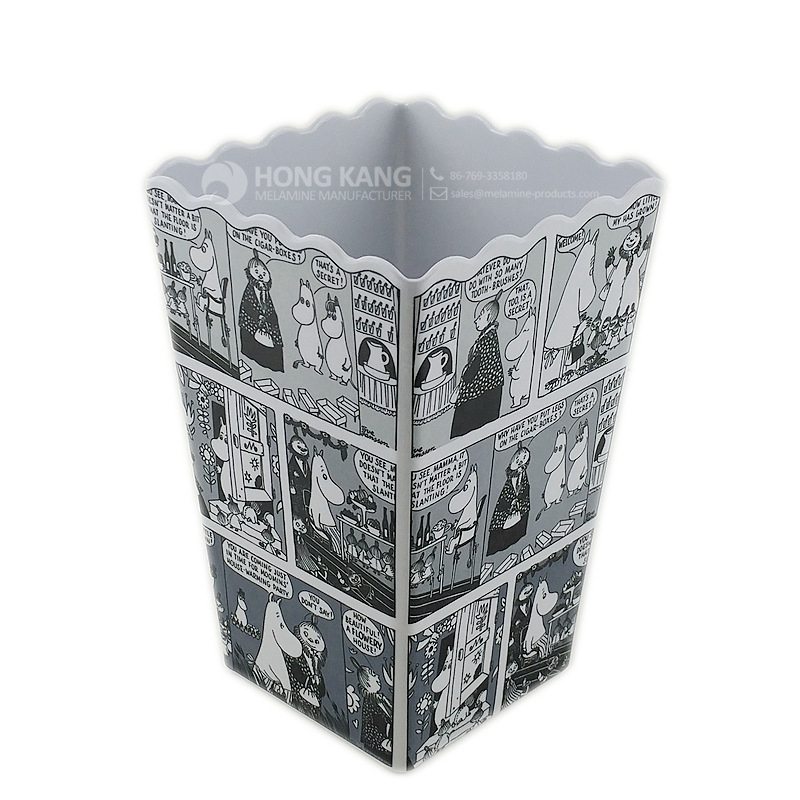
• Factory Supplier for melamine popcorn bucket for Botswana Manufacturer

    Product Detail

    Features

    Care Instructions

    Product Tags

    Related Video

    Feedback (2)

    We enjoy an extremely good status among our prospects for our great merchandise top quality, competitive price and the ideal service for Melamine pet scoop , melamine round plates , Melamine Two Tone Mug , If you are interested in any of our products, please feel free to contact us for more details. We hope to cooperate with more friends from all over the world.
    Factory Supplier for melamine popcorn bucket for Botswana Manufacturer Detail:

    Specification
    Item Name 4inch Square Melamine Popcorn Bucket
    Item No. BW269
    Shape Square
    Body Color White
    Decal Color 4 colors print (if need)
    Finish Glossy
    Style Fashion
    Motif Design Customized
    Shape Design OEM/ODM
    Test Standard FDA,PROP 65,EN71,LFGB etc. by SGS or ITS
    Packaging 6pcs/box,24set/carton
    Dimensions
    Length 10 cm
    Width 10 cm
    Height 15.6 cm
    Capacity N/A
    Material
    Body Material 100%melamine
    Decal Material (if need) 4 colors print (CMYK), or spot color printing, RoHS certificate
    Imprint (if need) Seiko ink type 1000 or other type, RoHS certificate
    Accessories Information
    Lid included No
    Other No
    Weights
    Net Weight (kg) 4.5
    Shipping Weight (kg) 5.6

    Product detail pictures:

    Factory Supplier for
 melamine popcorn bucket for Botswana Manufacturer detail pictures

    Factory Supplier for
 melamine popcorn bucket for Botswana Manufacturer detail pictures


    Related Product Guide:
    Benefits of Melamine Dinnerware
    The Benefits Of Using Silicone Kitchen Utensils

    We keep improving and perfecting our products and service. At the same time, we work actively to do research and development for Factory Supplier for melamine popcorn bucket for Botswana Manufacturer, The product will supply to all over the world, such as: Anguilla , San Francisco , Canada , Our technical expertise, customer-friendly service, and specialized products make us/company name the first choice of customers and vendors. We are looking for your inquiry. Let's set up the cooperation right now!

    FAQ: 1.Q: Where is your factory located? How can I visit there? A: Our factory is located in Guangdong province, China. Warmly welcome to visit us! 2.Q: What is the material of your products? A: The material is melamine.  3.Q: How can I get some samples? A: We can send the samples by Express/DHL/FedEx/UPS etc. 4.Q: How does your company do regarding quality control? A: We have a very strict QC system. Our inspectors have been closely monitoring the production process from the selection of raw materials to the final step of the finished products. 5.Q: Can you print our logo on the product & packing? A: Yes, We can print your logo on our products. Multicolor-Plastic-Dinnerware-Melamine-Dinner-Plate
    * Do Not Touch On Fire Directly
    * Do Not Washing By Steelwire Ball
    * Non-Microwave Ovens
    * Dishwasher Safe


  • The Great Gildersleeve (1941–1957), initially written by Leonard Lewis Levinson, was one of broadcast history’s earliest spin-off programs. Built around Throckmorton Philharmonic Gildersleeve, a character who had been a staple on the classic radio situation comedy Fibber McGee and Molly, first introduced on Oct. 3, 1939, ep. #216. The Great Gildersleeve enjoyed its greatest success in the 1940s. Actor Harold Peary played the character during its transition from the parent show into the spin-off and later in a quartet of feature films released at the height of the show’s popularity.

    On Fibber McGee and Molly, Peary’s Gildersleeve was a pompous windbag who became a consistent McGee nemesis. “You’re a haa-aa-aa-aard man, McGee!” became a Gildersleeve catchphrase. The character was given several conflicting first names on Fibber McGee and Molly, and on one episode his middle name was revealed as Philharmonic. Gildy admits as much at the end of “Gildersleeve’s Diary” on the Fibber McGee and Molly series (Oct. 22, 1940).

    He soon became so popular that Kraft Foods—looking primarily to promote its Parkay margarine spread — sponsored a new series with Peary’s Gildersleeve as the central, slightly softened and slightly befuddled focus of a lively new family.

    Premiering on August 31, 1941, The Great Gildersleeve moved the title character from the McGees’ Wistful Vista to Summerfield, where Gildersleeve now oversaw his late brother-in-law’s estate and took on the rearing of his orphaned niece and nephew, Marjorie (originally played by Lurene Tuttle and followed by Louise Erickson and Mary Lee Robb) and Leroy Forester (Walter Tetley). The household also included a cook named Birdie. Curiously, while Gildersleeve had occasionally spoken of his (never-present) wife in some Fibber episodes, in his own series the character was a confirmed bachelor.

    In a striking forerunner to such later television hits as Bachelor Father and Family Affair, both of which are centered on well-to-do uncles taking in their deceased siblings’ children, Gildersleeve was a bachelor raising two children while, at first, administering a girdle manufacturing company (“If you want a better corset, of course, it’s a Gildersleeve”) and then for the bulk of the show’s run, serving as Summerfield’s water commissioner, between time with the ladies and nights with the boys. The Great Gildersleeve may have been the first broadcast show to be centered on a single parent balancing child-rearing, work, and a social life, done with taste and genuine wit, often at the expense of Gildersleeve’s now slightly understated pomposity.

    Many of the original episodes were co-written by John Whedon, father of Tom Whedon (who wrote The Golden Girls), and grandfather of Deadwood scripter Zack Whedon and Joss Whedon (creator of Buffy the Vampire Slayer, Firefly and Dr. Horrible’s Sing-Along Blog).

    The key to the show was Peary, whose booming voice and facility with moans, groans, laughs, shudders and inflection was as close to body language and facial suggestion as a voice could get. Peary was so effective, and Gildersleeve became so familiar a character, that he was referenced and satirized periodically in other comedies and in a few cartoons.

    http://en.wikipedia.org/wiki/Great_Gildersleeve


    Check out how I made a laminated longboard for my wife using a vacuum bag and a wet/dry vac!
    Subscribe to my channel: http://bit.ly/1k8msFr

    Be sure to check out the X-Carve 3d carving machine from Inventables!

    http://www.inventables.com

    MORE PROJECTS, POSTS AND EVENTS

    http://www.iliketomakestuff.com

    HERE’S WHAT YOU’LL NEED:
    http://amzn.to/1VkPGSl – Wood glue
    http://amzn.to/1jvVuHG – Cutting mat
    http://amzn.to/1NZmmLh – Table Saw
    http://amzn.to/1KEhDfK – Spray Lacquer
    http://amzn.to/1h44qCe – Super 77 spray adhesive
    http://amzn.to/1VoWMQt – Silhouette Portait (vinyl cutter)
    http://amzn.to/1VoWXLz – Truck/Wheel combo
    http://amzn.to/1FF31OD – Grip tape
    http://www.roarockit.com/tap-kits.html – Thin Air press bag
    http://www.roarockit.com/veneer-1/ – Veneer pack
    http://meshcam.com/ – MeshCam
    http://www.123dapp.com/design – 123d Design

    Want to support ILTMS? Get early viewing, exclusive content and more…

    http://www.iliketomakestuff.com/patreon

    FOLLOW:

    http://twitter.com/iliketomakestuf

    http://instagram.com/iliketomakestuff

    http://facebook.com/iltms

    I brought each one into MeshCam and created a very simple tool path for the X-Carve to follow.
    Using a 2×2′ sheet of 1″ insulation, I cut it right down the center.
    I covered the entire surface with Super 77 spray adhesive and let it dry for a few minutes.
    I folded the pieces together, effectively making a 2″ piece of foam.
    I put the largest bit I had in my X-Carve, a 1/4″ ball nose bit.
    I screwed the foam panel into the waste board.
    I ran the tool path for each half on a different foam panel.
    After removing all of the surrounded, unwanted foam the two pieces fit together, but didn’t line up exactly.

    I attached the two panels to a piece of melamine with spray adhesive.
    The pieces lined up and I made sure they were secure to the melamine.
    I smoothed out the transition with a rasp in no time flat.
    The entire foam surface was covered with pacing tape to prevent damage to the foam in the lamination process.
    I measured the profile of the board shape, edge to edge.
    The veneer sheets I got were much larger than necessary, and they come with grain going in different directions for strength.
    I trimmed all of the sheets to length.
    Then I ripped them all down to fit the size of my form.
    I sandwiched the veneers, fully covering each with glue, and making sure to alternate grain direction between layers.
    I held the edges together with some packing tape so they wouldn’t slip around because of the glue.

    I slid the sandwich and the form into the vacuum bag, being careful not to snag the bag on anything.
    Over the sandwich, but under the bag valve, I slid in a strip of nylon mesh. This helps make sure the valve doesn’t get blocked before the vacuum is complete.
    The end of the bag was sealed up with some very sticky black glue/tape.
    The shopvac hose fits over the valve, and when turned on, it pulls out almost all of the air.
    I switched over to the included hand pump to pull out the last bits of air.
    After it dried for 8 hours, I pressed the valve to release the vacuum.

    Next, I flipped the paper over and traced the shape to the other side.
    This gave me a complete, symmetrical template to use.
    I drew a center line and added a light coat of spray adhesive to the blank.
    I added the template by lining up the crease with the center line.
    Then the other side laid over into place as well.
    I used a bandsaw to cut out the shape, but you could also use a jigsaw.
    I smoothed out my bandsaw cuts with a belt sander.
    I used an orbital sander to give the edges a very slight round over.
    Since I used a light coat of spray adhesive, the  template pulled off easily.
    I lined up the trucks, and used a straight edge to make sure they were lined up with each other, then marked the holes for each.
    I added a block underneath to prevent blowout, then drilled all eight holes.
    I assembled the wheels and trucks, which is extremely simple.
    I cut out some graphics on my vinyl cutter to use on the bottom of the board.
    After peeling away the extra, I added a sheet of transfer paper over the remaining vinyl.
    Then using a utility knife, I cut the individual stickers out.
    I peeled off the backing from the vinyl, which leaves it attached to the transfer paper.
    Then I masked off the areas along that border with blue tape.
    I put down a few coats of black spray paint in the exposed areas.
    After drying, I removed the tape.
    The bottom surface was protected with a couple of coats of spray lacquer.
    I got some red grip tape. I peeled off the backing and rolled it over the top surface, making sure not to let bubbles form underneath.
    I ran a screwdriver around the edge to score the grip tape.
    The scoring mark helps to make the cut cleaner. I cut off the excess with a utility knife.
    I poked through, from the under side in each of the eight truck holes.
    The riser pad slides over the screws before adding the truck and nuts. Second channel: bit.ly/iltms-2

    The sales manager is very patient, we communicated about three days before we decided to cooperate, finally, we are very satisfied with this cooperation!
    5 Stars By Irene from Cape Town - 2016.02.18 15:54
    Customer service staff and sales man are very patience and they all good at English, product's arrival is also very timely, a good supplier.
    5 Stars By Juliet from Ghana - 2016.06.25 12:48

    Related Products

    WhatsApp Online Chat !